 Kaufmännische Berufschule
 Wirtschaftsgymnasium
 Kaufmännisches Berufskolleg I
 Kaufmännisches Berufskolleg II
 Berufskolleg Fremdsprachen
 Kaufmännische Berufsfachschule
 Berufsvorbereitung
Weltacker
In recent years the environment has been facing unimaginable challenges. Industrialisation and rapid technological breakthroughs have led to a skyrocketing standard of living, however also to the destruction of our natural surroundings: extinction of species, deforestation, mass pollution and of course climate change are issues that demand our immediate attention.
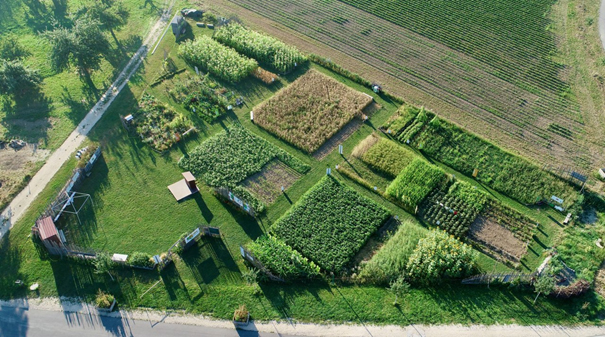
And that is exactly where the concept of “überlinger Weltacker “concept starts. The Weltacker is an agricultural project, a farming initiative that aims to draw attention to the global nutrition question, to raise awareness about sustainable and (although it might sound paradox) renewable agriculture and the environmental footprint of food production in our world.
The Weltacker project is limited to the south of German speaking nations. Besides Berlin, they are all in Bavaria, Baden Wurttemberg, Switzerland and Austria. The one in Überlingen is looked after by Eva Hauber, Jannis Richter, Katharina Staib and Anette Wilkening. They are not only looking after the acre but also organising tours and workshops.
The Weltacker, founded in 2020, is a project which visualizes the agricultural production inside an area of 2000 m². This area isn’t just a random number, it shows us the total agricultural area on earth divided among all people. So this is theoretically the space every human would get if the space was equally divided between all of us.
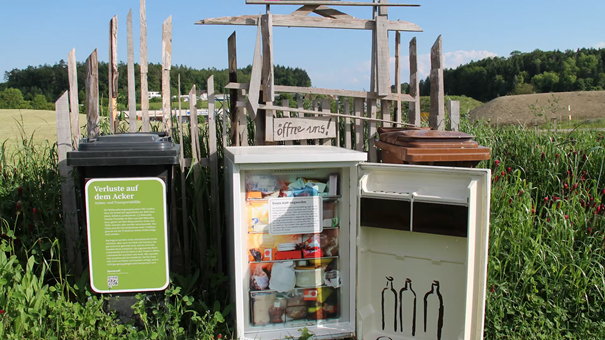
In June 2023 we actually got the privilege to get a private tour around the “überlinger Weltacker” with our class. We had a very nice, friendly, and experienced guide who could answer many of our questions. At first, she showed us the 2000 m² area and my first impression was that it was way smaller than I first expected it to be. She also showed us the different parts in which the acre is divided. It was very interesting to see how much of a certain crop is grown worldwide. I had no idea that there is such a high demand of for example rice, soy or wheat compared to for example rye. During our tour the guide also told us about our food waste, about 30 % of the food is thrown away immediately so basically 30 % of our own acre is useless if we don’t change “throw-away-policy “.
Although the “Weltacker” concept is undoubtedly a very important project, there is also some criticism about it for example the oversimplification of certain agricultural aspects which leads to a generalization. It excludes that there are different circumstances and challenges that are different from country to country.
All in all, the “Weltacker” is a very good way of introducing people to the topic of consumption, food waste, biodiversity and fair distribution.
Marc Zauner WG-E3, English class of Mrs. Czerwoniak (gekürzte Version)